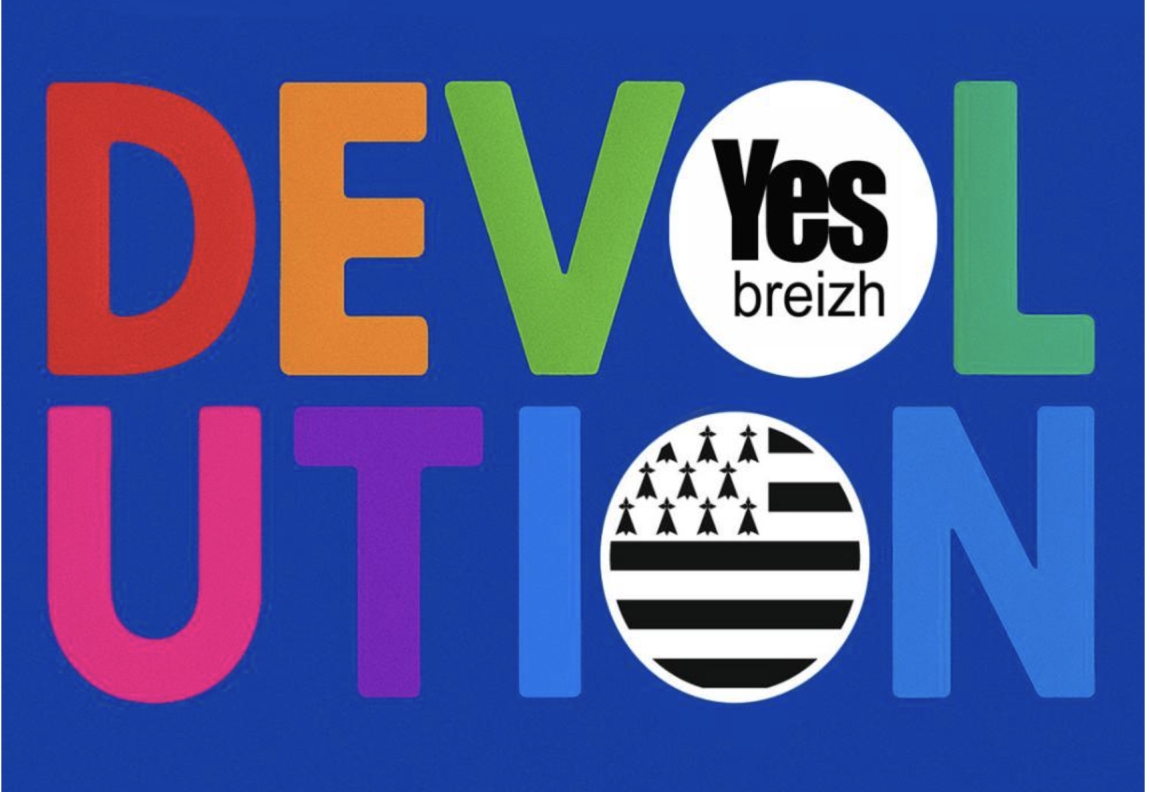
What is Yes Breizh ?
Réalisation : ABP – 112 vues
Devolution for Brittany is a process that would give Brittany a new status, like Wales, Bavaria, and many other countries and regions in Europe.
Devolution for Brittany is a process that would give Brittany a new status, like Wales, Bavaria, and many other countries and regions in Europe. The state of politics in France puts each of us at risk—economically, environmentally, culturally, socially, and more. Yes Breizh, an association (not a political party), wants to bring all Bretons together to launch a devolution process, meaning the transfer of powers to Brittany.
What is devolution ?
What is dévolution ? For several years now, Brittany’s institutional future has been discussed in terms of autonomy and independence. The first term is overused; the second is too divisive and too destructive. Yes Breizh proposes using another word instead: a term that brings people together and opens a realistic, well-structured future : dévolution.
This word means transferring powers from a central state to a country or a region. For Brittany, it would mean building real authority within a clear and transparent democratic framework.
Origin and meaning of the word devolution
The word « dévolution » comes from the Latin devolvere: « to roll down », « to transfer ». In French legal language, it means « to transfer a right or an office », for example in an inheritance. In politics, it refers to something broader: the transfer of powers from central government to a local or national entity.
Dévolution is a forward-moving process implemented gradually, step by step, in a regular and structured way. The term « dévolution » became especially important in the United Kingdom toward the end of the 20th century.
The example of the United Kingdom
In 1997, the United Kingdom began a major constitutional reform: « devolution of power ». Through this reform, substantial powers were granted to Scotland, Wales, and Northern Ireland in several areas: health, education, agriculture, culture, the economy, and more.
– Scotland: creation of the Scottish Parliament and a government in Edinburgh. Scots now hold significant powers, including in taxation.
– Wales: establishment of the "Senedd" (Welsh Parliament) and a government in Cardiff, with powers that have increased gradually.
– Northern Ireland: a more complex system, based on power-sharing between communities, but which also demonstrates how dévolution can function.
After more than 25 years, dévolution has enabled these nations to strengthen their democracy, align public policy more closely with local realities, and give a clearer institutional expression to national identity. Debates remain—especially in Scotland regarding independence—but the United Kingdom has not collapsed because of it.
Devolution, autonomy, independence: clarifying the terms
To be clear, it is important to distinguish three concepts:
– Autonomy: broader local powers, but still tied to and ultimately controlled by the central state.
– Independence: full sovereignty; creation of a separate state, with its own diplomacy, army, and currency.
– Dévolution: a gradual process, with defined stages, transferring specific powers to a country or region. It can lead to very broad autonomy, even to independence if the people decide—but it does not require choosing the final outcome from the start.
That is why Yes Breizh prefers this term: it is clear, pragmatic, unifying, and oriented toward the future.
Why devolution for Brittany?
For centuries, French centralization has constrained Brittany. Its institutions and government were abolished in 1789. It was reduced to being only a « region » like the others, with its tools and resources often placed under the authority of Paris.
The consequences include:
– political representation that is too weak
– budgets repeatedly inadequate for real needs
– major delays in media and infrastructure
– contempt for its culture and language
Brittany is treated like a remote periphery of the center, even though it has major strengths:
– a young and capable population
– an economy open to the world
– a strong culture that is open to everyone
With devolution, Brittany could regain control over decisions that concern it, manage its resources, and respond to its real needs.
Key areas of devolution in Brittany
To be effective, devolution would need to apply to several fields:
– Health and social services: organize hospitals, prevention policies, support for people living with disabilities and those who need assistance
– Education and culture: school programs connected to Brittany, recognition of Breton and Gallo, development of arts and sciences, teaching the history of Brittany
– Economy and taxation: collect taxes in Brittany for Brittany, support small and medium-sized businesses, build an innovation strategy
– Energy and environment: manage offshore wind power, energy transition, protect coastlines, and more broadly pursue sustainable development through a coherent and responsible ecology
– Agriculture and fishing: align European policies with Brittany’s realities
– Housing and land-use planning: fight housing speculation, regulate second homes, invest in social housing in rural areas
– Transport and infrastructure: modernize the rail network, strengthen connections between cities, ports, and airports
– Political representation: create a Brittany Assembly and an executive accountable to citizens
« It can’t work »? Objections and answers
Too small… in terms of territory? With 34,000 km², Brittany is larger than Belgium (30,688 km²), larger than Slovenia (20,273 km²), and only slightly smaller than the Netherlands (41,543 km²). Many prosperous states have even smaller territories.
Too small… in terms of population? Brittany—meaning the administrative region plus Loire-Atlantique—has close to 5 million inhabitants, comparable to Slovakia, the Republic of Ireland, or New Zealand, and far more than Croatia, Slovenia, or the Baltic states. Those countries are independent; some are in the European Union. No one suggests their status is « too much » for their size.
The example of the German Länder: Germany shows this even more clearly. States such as Saarland (around 990,000 inhabitants) or Bremen (around 680,000 inhabitants) have their own parliaments, governments, and broad powers. Brittany, with about 5 million people, has more legitimacy than many German Länder—yet those Länder manage their affairs in a full and structured way.
Brittany is neither too small nor too poor. It has simply been deprived of the tools to act.
A democratic, step-by-step process
Dévolution can only happen if the people of Brittany want it. That requires an open and clear public debate, followed by a democratic vote—for example, a referendum. That is the objective of Yes Breizh.
A realistic timetable could be set toward 2032, with clear stages:
– Launch a public and media debate
– Hold a referendum in Brittany to seek the public’s view
– Review the French constitutional framework
– Elect a Brittany Assembly and establish an executive accountable to citizens
This gradual process helps avoid sudden ruptures and builds, step by step, a new framework of trust between Brittany and France.
Devolution and a shared future
Dévolution does not mean cutting ties with the central government. It means redefining that relationship on a fair and respectful basis. Paris would still retain certain « sovereign » powers: diplomacy, the army, currency. Brittany would take responsibility for most social and economic policies.
At the same time, Brittany could strengthen its place in Europe and the world:
– direct relationships with Ireland, Scotland, and Wales
– openness to the Atlantic and the Celtic Sea
– active participation in European regional networks
Devolution: a word, a project, renewed confidence
Devolution is not just a slogan. It is a proven political tool that has shown its effectiveness elsewhere. For Brittany, it is a historic opportunity:
– an opportunity to regain control of its future
– to build a fairer and more effective society
– to restore confidence to younger generations
Neither vague « autonomy », nor sudden « independence »: dévolution lays out a clear, democratic, and structured path—so that Brittany can truly become master of its destiny while remaining open to the wider world. That is the goal of Yes Breizh, beyond today’s political divisions, which have become increasingly outdated.
Spokesperson for Yes Breizh
To support Yes Breizh To join Yes Breizh

Commentaires (0)
Aucun commentaire pour le moment. Soyez le premier à réagir !