Through a report conducted in Odessa in September 2025, Breton journalist Erwan Chartier-Le Floch describes the daily life of a large Ukrainian city living under the constant threat of Russian drones and missiles. Blending on-the-ground narrative, historical reflection, and identity questions, "The Sirens of Odessa" offers a sensitive dive into war-torn Ukraine.
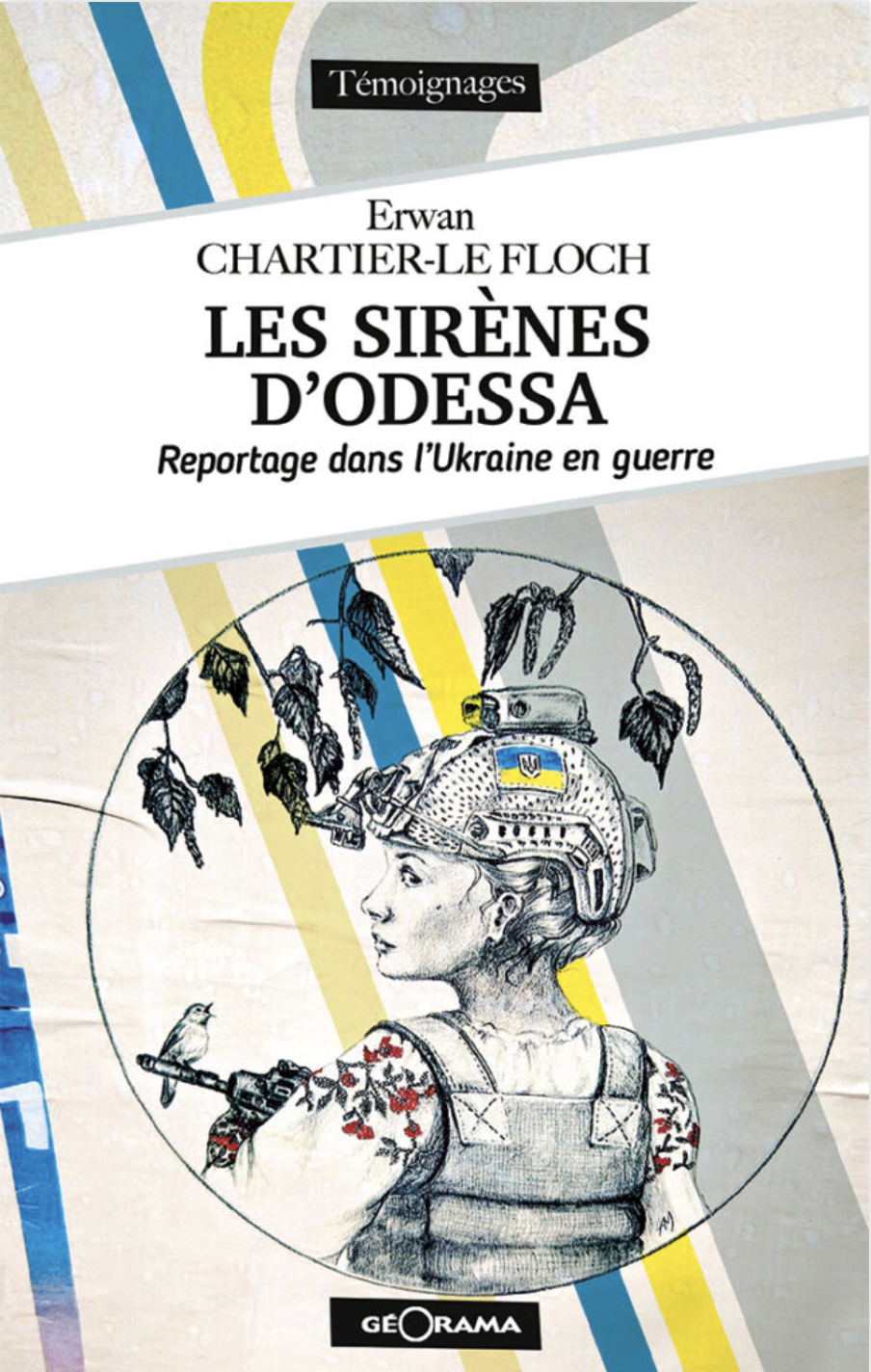
With "The Sirens of Odessa, Reportage in War-Torn Ukraine," the journalist, historian, and writer delivers a sensitive and embodied testimony about Odessa, a major port city on the Black Sea that has become one of the symbols of Ukrainian resistance. This 156-page work, which can be read quickly, is the result of an immersive report conducted in September 2025 in this war-torn city. Odessa is a city founded at the end of the 18th century and known for its unique architecture, historical heritage, dynamic port, and festive atmosphere. It continues to live with that spirit of resistance that we all admire.
I tried to describe as honestly as possible what I saw, heard, and felt. This is not an academic memoir, but as a trained historian, I have added several notes that help shed light on what is happening and unfolding in this part of Eastern Europe, which has been plagued by a terrible conflict since 2014, or even since the end of the 20th century - Erwan Chartier-Le Floch
Accompanied by his Breton friend Fañch Danion, already familiar with Odessa where he has a second home, Erwan Chartier-Le Floch flies to Moldova in September 2025 before taking a taxi to Odessa.
A Ukrainian city, largely Russian-speaking but not necessarily pro-Russian, Odessa appears here as a complex and contradictory city, where humor, fantasy, and a certain lightness continue to exist despite the proximity of the front, located just a few dozen kilometers away.
The title of the book plays on a double meaning: the "sirens" evoke both the mythological creatures from the Greek tale of the Odyssey, which is said to have given its name to the city linked to the Black Sea, and the air raid alarms that now punctuate the daily lives of the residents.
Modern war tragically invades urban space. Some streets and infrastructures, like those in Kherson, are now protected by large nets, some of which come from Breton ports, intended to limit attacks from Russian kamikaze drones, a concrete illustration of the country's ongoing adaptation to this war where civilians are targets. The goal for the Russians is to make them flee.
What makes a country at war, even in a city in the rear? the author wonders through his encounters and strolls in a city living under the constant threat of missiles and drones. The book does not limit itself to a description of the military conflict: it focuses primarily on the details of daily life, the reactions of the inhabitants, and the particular atmosphere of a society forced to live with war. Certainly, Chartier-Le Floch is surrounded and guided by Bretons, or more broadly by French speakers established in Odessa, but he also meets fighters committed to the freedom of their country.
Beyond the reportage, Erwan Chartier-Le Floch also addresses the historical and memorial dimension of the conflict. The war is also played out around history, identities, and national narratives that diverge, or even oppose each other. This is indeed the title of chapter 3, entitled "The War of History." The ambitions of reconquest claimed by the Russian power date back to Imperial Russia. Formerly called "New Russia," the old name of this region in southern and eastern Ukraine has become a propaganda tool in the Kremlin's discourse.
The second chapter, dedicated to the history of Odessa, particularly revisits this city created by Catherine II, whose plans were established under the authority of the Duke of Richelieu (1766-1822), who was its governor.
Chapter 3 unfolds the story of Ukraine, particularly its struggle to become a sovereign state in the context of the revolution and World War II. Dubious alliances, such as that of Bandera with the Nazis, are not overlooked. This period will resonate with Bretons who are familiar with the fractures and ambiguities that Brittany experienced during the war, of course on a scale incomparable to the Ukrainian tragedy. The tragedy of Ukrainian nationalists is that they were often forced to choose between the Bolsheviks and the Nazis, between genocide by famine (the Holodomor) and genocide by deportation.
Political mistakes are not ignored: The Zelensky government's desire to impose Ukrainian everywhere is rejected by the residents of Odessa, even though they want to remain Ukrainians. This political error has served as a pretext for the Russians to invade.
The author also explains why Bolshevik leaders attached Crimea and Donbass to the Ukrainian Soviet Socialist Republic. The aim was to expand the Russian-speaking space of this satellite republic in order to neutralize Ukrainian nationalism. An analysis that is reminiscent of certain territorial dilution logics known elsewhere, particularly in France, with the famous Grand Est or the Grand Ouest project.
About the Author
Editor-in-chief of the Breton cultural magazine ArMen and director of the weekly Le Poher in Carhaix, Erwan Chartier-Le Floch is one of the figures of contemporary Breton cultural and historical journalism. A doctor in Celtic studies, a teacher at the University of Rennes 2, and a recognized specialist in Celtic worlds, he has devoted a large part of his work to the history of Brittany, regionalist movements, intercelticism, as well as identity and linguistic issues.
Author of around twenty works, he has notably published "The Breton Question," "History of Intercelticism in Brittany," "History of Brittany in One Hundred Dates," "The FLB File," "Atlas of Celtic Worlds," and several biographies dedicated to Gilles Servat, Morvan Lebesque, and Jean-Yves Cozan. For many years, he has also signed dozens of investigations, reports, and in-depth articles in ArMen, dedicated to heritage, history, and the cultural and political developments of Brittany.
With "The Sirens of Odessa," he is now interested in an international conflict while maintaining his field approach, his interest in memory and identity issues, as well as his attention to human realities.
The book will be published on May 30 by Géorama at the price of only 12 euros.


Commentaires (0)
Aucun commentaire pour le moment. Soyez le premier à réagir !