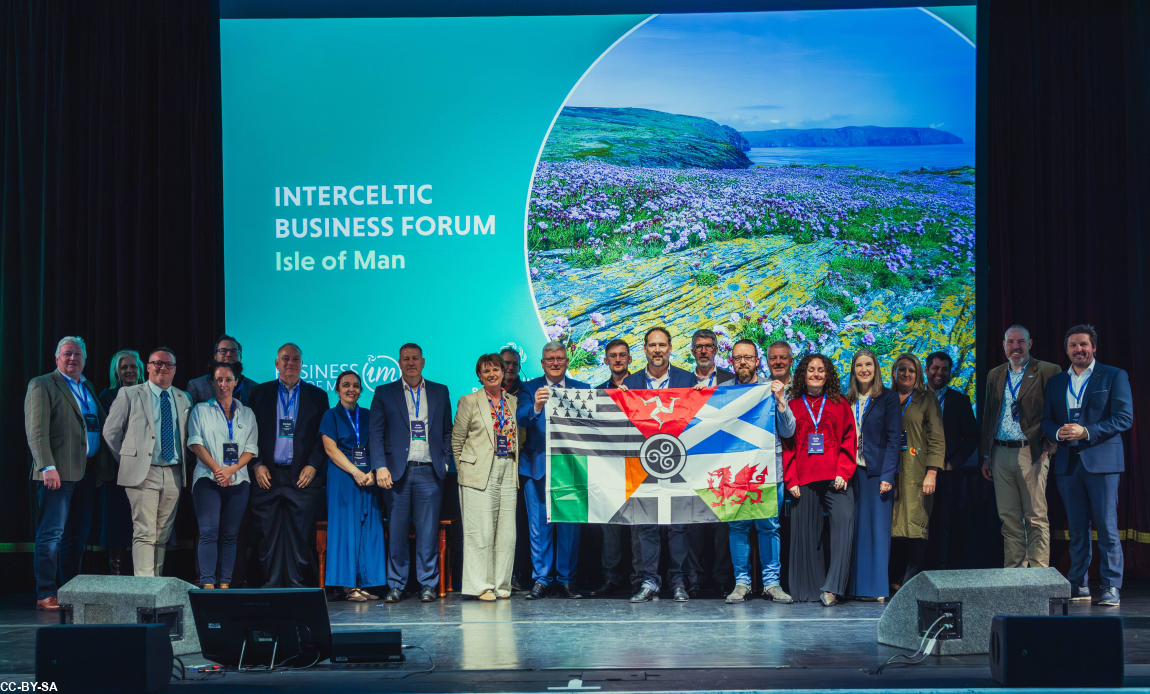
Inaugurated in Lorient during the Interceltic Festival of Lorient in 2016, the Interceltic Business Forum was held for the first time on the Isle of Man in Douglas, bringing together business leaders, investors, public officials, and innovators from all Celtic nations. Following editions in Galway, Cardiff, and Falmouth, this new stage confirms the growing importance of this original economic meeting point, at the intersection of economic, cultural, and territorial issues.
The event was opened by the Prime Minister of the Isle of Man, Alf Cannan, alongside the director of Business Isle of Man, Kirree Gooberman, and the founder of the forum, Charles Kergaravat. All emphasized the need to strengthen cooperation between Celtic territories, in a context of increased economic competition but also of reaffirmation of regional identities.
An economic approach rooted in Celtic identities
From the very first discussions, the forum highlighted a central idea: Celtic territories should not be defined by their size but by their capacity for initiative and their international openness.
Beyond traditional economic exchanges, the forum distinguished itself through its integrated approach: economy, culture, diaspora, and identity are addressed as complementary levers. This vision, still rarely present in major traditional economic forums, constitutes one of the hallmarks of this initiative. Brittany was represented by two actors, AudéLor and Fidal Bretagne, indicating a still modest but committed presence in this inter-Celtic economic network, despite the absence of direct connections with the Isle of Man.
An island economy in full expansion
The hosting of the event allowed the Isle of Man to showcase its economic model, based on agility, innovation, and strong attractiveness for businesses. Participants were able to discover a local ecosystem structured around key sectors: innovation, engineering, tourism, maritime, and manufacturing industries.
Local businesses took advantage of this visibility to establish direct contacts with actors from Ireland, Scotland, Wales, Brittany, or Cornwall. The event thus played a concrete role in networking, beyond its symbolic dimension.
Artificial intelligence and innovation at the heart of discussions
Innovation, and particularly artificial intelligence, constituted a major focus of the discussions. Speakers emphasized a dual challenge: to leverage the opportunities offered by these technologies while avoiding a widening of inequalities, especially for minority languages.
Tomás Ó Síocháin warned against the risk of marginalization of small linguistic communities in the development of digital tools. Conversely, Declan Ivory presented already concrete uses of AI in businesses, particularly to improve customer relations and operational efficiency.
A specific session also demonstrated how these technologies can contribute to the preservation of Celtic languages, using Manx as an example.
Diaspora and networks: a strategic lever
Another structuring theme was the role of the diaspora. Far from being approached solely from a cultural angle, it was presented as a genuine tool for economic development. Speakers like Aisling Moroney showed how Ireland mobilizes its networks internationally. A roundtable including Nicola Lloyd (Global Cornish) and Allan Mulrooney from the Western Development Commission (in Ireland) emphasized the ability of Celtic diasporas to generate business opportunities, thanks to networks based on trust and belonging.
Sustainable tourism and responsible economy
The forum also addressed the issue of more responsible economic growth. The tourism sector was particularly highlighted, with examples of businesses engaged in environmental certification processes (B-Corp).
Discussions highlighted a shift towards tourism models that are less focused on volume and more oriented towards quality, local impact, and the preservation of natural resources. This is particularly relevant for island territories like the Isle of Man, recognized as a biosphere reserve by UNESCO in March 2016.
Industry, Maritime, and Local Know-How
Several sessions showcased traditional sectors, particularly maritime and manufacturing industries. These exchanges reminded participants that Celtic economies do not rely solely on services or digital sectors, but also on industrial know-how capable of fitting into international markets.
The example of local companies, particularly in high-end textiles, illustrated this ability to combine territorial anchoring with global competitiveness.
Investment and Structuring Ecosystems
The issue of financing for businesses was also addressed, with input from Mary McKenna. Discussions highlighted a shared challenge faced by many Celtic regions: facilitating access to capital and structuring ecosystems that are conducive to the growth of start-ups.
The forum emerged as a concrete tool to strengthen these networks by connecting entrepreneurs, investors, and public decision-makers.
A Dynamic Set to Continue
Beyond this day, several initiatives were announced: a meeting during London Tech Week, the launch of an Interceltic Startup Challenge, and the next edition of the forum scheduled for August 3 in Lorient.
These prospects confirm that the Interceltic Business Forum is not limited to a one-off event, but is part of a long-term strategy aimed at structuring a genuine inter-Celtic economic network.
By hosting this edition, the Isle of Man demonstrated its ability to fully integrate into this dynamic. The forum confirms, edition after edition, the emergence of a unique space for cooperation among Celtic territories, where economic development, cultural identity, and political ambition tend to converge.

Commentaires (0)
Aucun commentaire pour le moment. Soyez le premier à réagir !