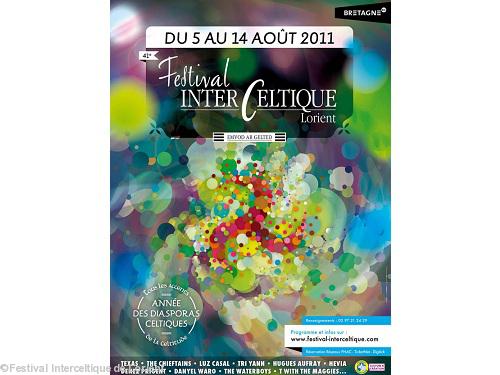
Over the past forty years, the Lorient Interceltic Festival has become an international crossroads, showcase and centre of creativity, based on a contemporary and open concept of identity. Editorial by Lisardo Lombardia, Festival director
Editorial by Lisardo Lombardia, director
Over the past forty years, the Lorient Interceltic Festival (LIF) has become an international crossroads, showcase and centre of creativity, based on a contemporary and open concept of identity.
The vicissitudes of history have forced Celtic communities living on the Atlantic coastline to leave behind their families and set sail in all directions of the compass. North America welcomed large groups of Irish and Scottish settlers; Acadia welcomed Bretons. Latin America received migratory waves of Galicians and Asturians, but also Welsh who settled in Patagonia, and Cornish in Mexico. The Spice Route was dotted with Bretons at the time of the India Company whose headquarters were in the town of Lorient (L'Orient). In Australia and New Zealand, a significant amount of Europeans who settled in the Southern hemisphere were of Celtic origin.
Many of these diasporas have continued to practice their music and their mother language despite mixing and integrating into their new communities. Therefore, several generations later, one may come across many Argentines proud of their Galician roots, Mexicans playing the gaïta and calling themselves Asturian. Many Canadians from Cape Breton or Prince Edward Islands could compete against the best soloists of the Scottish fiddle or the great bagpipes.
In New York, for the past 25 years, thousands of Americans participated in the Saint Patrick's Day Parade, wearing a green hat, proclaiming their Irish roots.
These are all of the Celtic colours that you will see in Lorient this summer. The poster for this year's edition highlights this Celtic cosmopolitanism: proud of its roots, open to the world and perpetually curious…
Faced with the challenge of globalization, we are entering a new decade, convinced that the Celtic attitude or “Celtitude” has more to do with the future than with the past. We value this diversity and the creativity of the Celtic diasporas from all over the globe.
Let's celebrate “All accents of the Celtitude”. There is a whole world to be discovered!
Lisardo Lombardia, Festival Director
Documents liés
-
 Lorient Interceltic Festival August 5th-11th 2011. Press Release.
Source : Festival Interceltique de Lorient
Lorient Interceltic Festival August 5th-11th 2011. Press Release.
Source : Festival Interceltique de Lorient
-
Lorient Interceltic Festival 5th-11th 2011. Programm (in French).
Source : Festival Interceltique de Lorient

Commentaires (0)
Aucun commentaire pour le moment. Soyez le premier à réagir !