From the besieged skies of Paris to the hostile lands of Alsace, from clandestine marches to the tragic quagmire of Conlie, Joseph-Marie Le Bouédec navigates the war like a ridge line, between audacity and fatality. Buffeted by the winds, hunted, wounded, he embodies that breed of men that nothing truly breaks. But behind the epic tale lies another truth: that of a more muted struggle, where waiting, abandonment, and mud consume strength. A breathless life, stretched toward a single goal — to hold on, always, until returning to the...
Joseph Marie Le Bouédec, a Trégorrois between sky and war
A Breton shaped to endure
Joseph-Marie Le Bouédec was born in Pontrieux in January 1829, in a Trégor of granite and wind, open to the sea. He belongs to an old family from Central Brittany, shaped by generations of men rooted in the land and their word, who pass down the country as one passes down a way of being. There, one learns early to contain the impulse of the heart, to decide quietly, and to endure.
A few years of study in Tréguier, then in Rennes, and finally at Saint-Cyr, forge a methodical and determined temperament. Le Bouédec serves in Crimea, is wounded at Sevastopol, cited for his conduct in battle, decorated. He knows real war, the kind that shapes bodies and commands action.
From these campaigns, he returns seasoned, but not inclined to the abstractions of peace. He struggles with the weight of procedures, the slowness of offices, and the piling up of rules. Following a disagreement with the institution, he leaves the army. But an officer trained in battle never truly leaves war.
Paris encircled
In the autumn of 1870, France is faltering. The Empire has collapsed, the armies are retreating, Paris is encircled. The city is suffocating under the Prussian blockade. Supplies are running low, the news is bad, the horizon is closing in.
Le Bouédec, recalled to service, finds himself in this besieged capital. He is no longer a young officer seeking a future, but a mature, tested, and clear-eyed man. He is entrusted with a mission as audacious as it is desperate: to leave Paris to join the provincial forces, to attempt to coordinate the resistance.
The only way out is the sky.
The departure by balloon
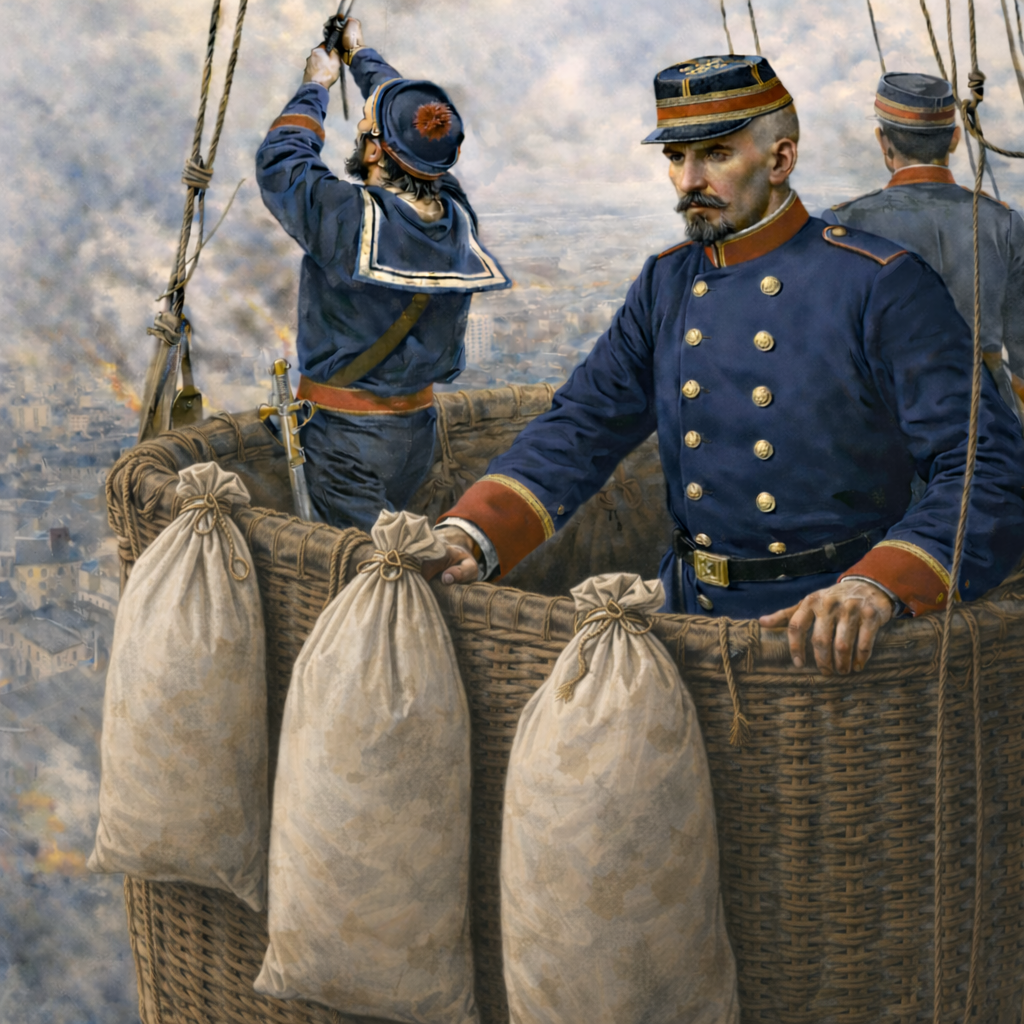
On Tuesday, October 25, 1870, at dawn, the balloon Le Montgolfier rises from the Orléans station. In the basket are pilot Hervé Sené, Colonel Delapierre, and Commander Le Bouédec.
In a few moments, the world tilts beneath their feet, and Paris slowly recedes, engulfed in mist. The balloon continues its journey for a long while above a closed sky, gliding over clouds that erase all reference to the ground. Unable to pinpoint their exact location, believing they are approaching Verdun, they attempt to initiate a descent. Unfortunately, they emerge above a Prussian position. Shots ring out immediately. Hervé Sené, who is steering the balloon, hesitates for a second. He was not born for this; he is a sailor, he knows how to read the wind on water, not in the void. The fabric is struck, torn. They must throw out ballast. Then again. Two full bags of mail disappear into the void.
Now the balloon rises again. Too much.
In vertical drift
The ascent becomes uncontrollable. The air thins abruptly. The cold bites. The ears buzz, ready to burst. Movements become slow, imprecise. The men are suffocating. Suspended between sky and death, they feel their strength abandoning them.
In this silent struggle against fainting and cold, Le Bouédec acts. Not out of spectacular heroism, but by that reflex forged by war: not to yield as long as hope remains. He forces the maneuver again and again, fighting against the machine, against the void, against himself.
For a moment, it seems sufficient. As if something up there had finally given way, the balloon suddenly begins its descent — a promise of salvation immediately denied. The aerostat falls in jerks, tossed by the currents, drawn toward the ground. The fabric snaps, the ropes groan, the basket sways dangerously. Below, the ground approaches too quickly. Trees emerge, the contours sharpen. There is nothing left to do but wait, grit their teeth, and prepare for impact.
Heiligenberg: the fall
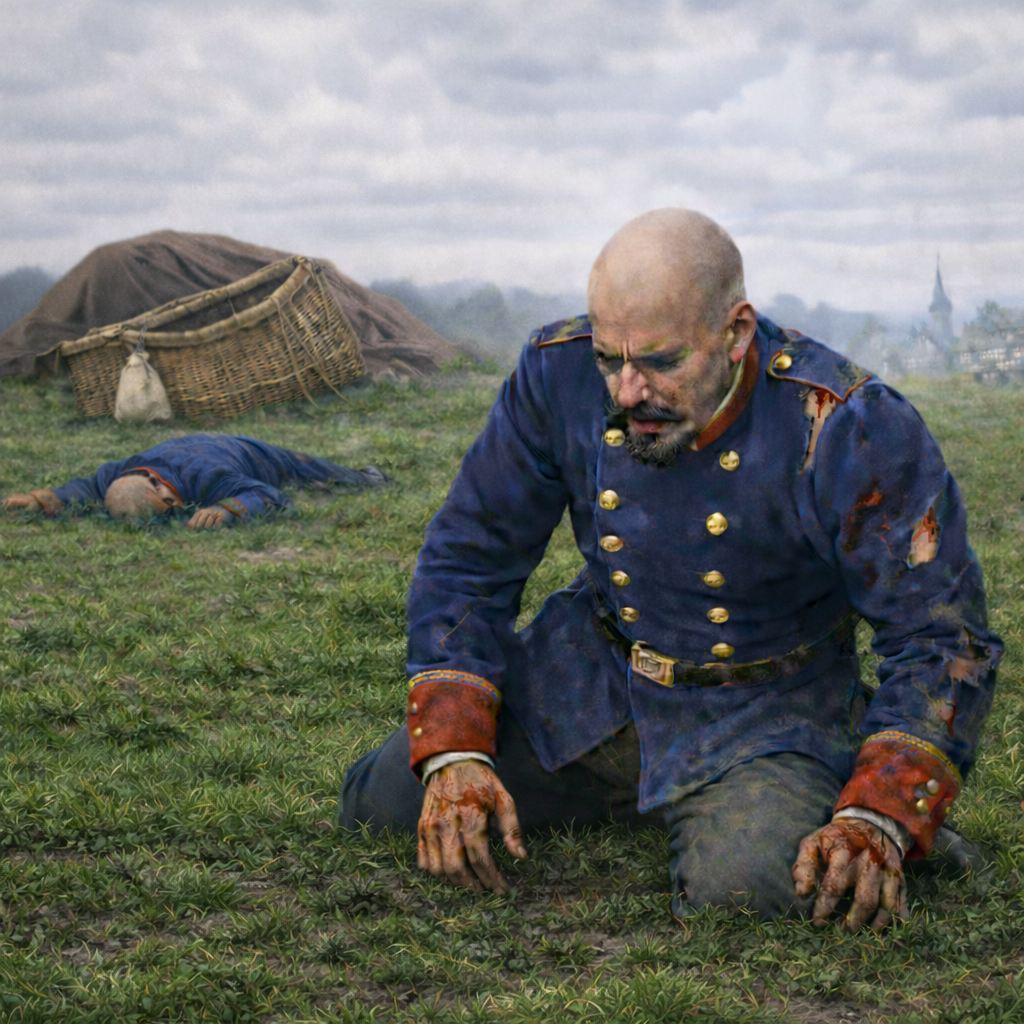
The basket violently hit the ground in Alsace, on the heights near the village of Heiligenberg. The impact is extremely brutal. The balloon, already riddled with dents, collapses suddenly, and the three men are thrown out of the basket, hurled to the ground among the ropes and the torn fabric.
For a few moments, nothing moves. The bodies lie stretched out, battered, gasping. The limbs burn, the skulls buzz, blood flows. Then one of them tries to get up, staggers, clings to the ground. The others follow. They are injured, bruised, but alive.
And, by miracle, they can walk.
The danger, however, returns immediately. The airship has been spotted. The Prussians, stationed five kilometers away in Mutzig, know that it could not have gone far.
Salvation through mutual aid
They must disappear, and quickly!
Having seen the balloon fall and understanding that these are compatriots who survived an incredible crash, the inhabitants of Heiligenberg intervene without hesitation. Men rush in. The fabric is quickly hidden, cut up, buried in the woods and barns. The basket is hastily dismantled, scattered piece by piece. The mayor and the priest take charge of the operations, organizing, deciding. Everyone knows what they risk. No one backs down. No one shirks.
The injured are sheltered. The wounds are cleaned, the limbs bandaged in haste. Time is pressing: the Prussian patrols are already approaching the outskirts of the village.
They must improvise another escape.
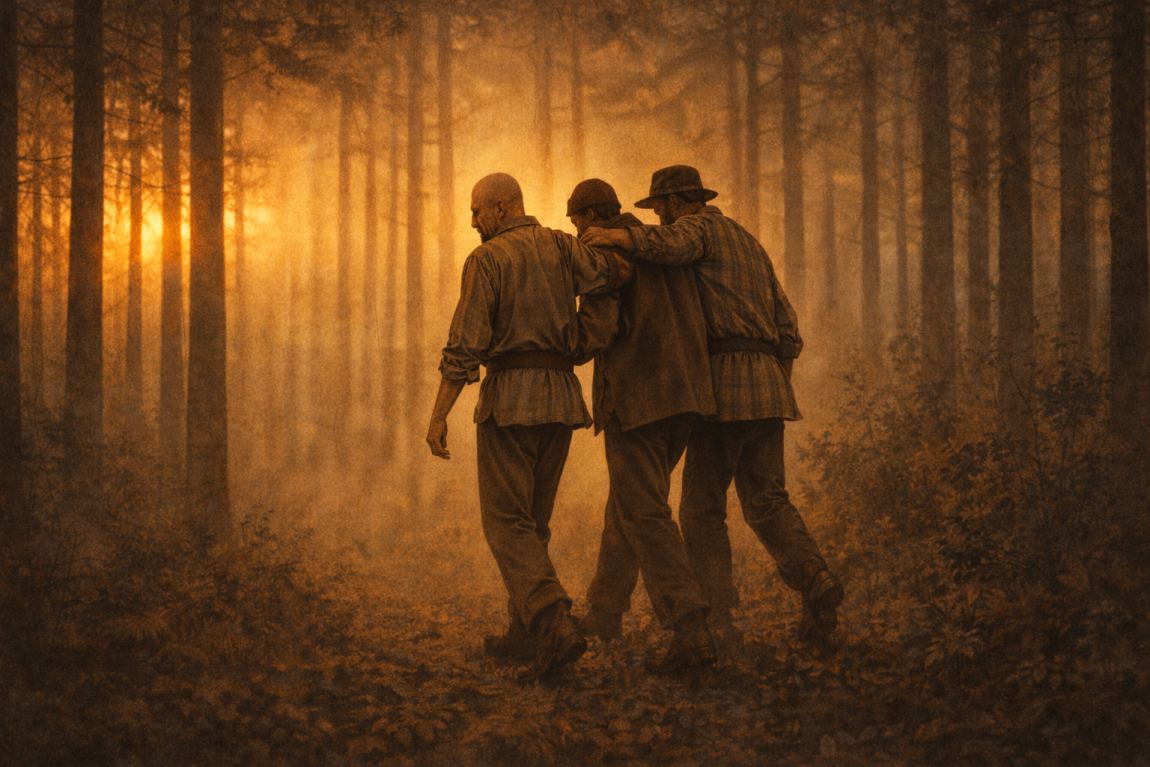
Coarse clothing circulates, work clothes, worn jackets, wooden shoes. An axe, a few tools pass from hand to hand. Nothing of a transformation — just a necessary disguise. Le Bouédec and his companions take on the appearance of lumberjacks to deceive the onlookers, blend into the ordinary, survive. Then the forest engulfs them, hides them, and closes its silence around them.
The march
As the trio moves away, the Prussians are already searching the village in Heiligenberg. The inhabitants are roughly treated, interrogated without mercy. No one speaks.
The threat falls, brutal: since no one wants to talk, the village will be burned. To save it, a ransom of ten thousand francs is hastily gathered, each giving what they can, then paid.
Later, in his report, Le Bouédec will express his deep gratitude several times towards these Alsatians who fell from the sky.
For the trio of survivors, another trial begins, longer, more silent. Through forests and hollow paths, they walk. Most often at night. They encounter patrols, bypass villages, stop, and set off again. Every step is a pain, every detour a caution.
In four days, they cover more than one hundred sixty kilometers, through a country held by the enemy. The fatigue is extreme, but no one stops.
Le Bouédec moves forward without flair, without complaint, driven by an inner strength that prioritizes momentum over suffering.
Finally, after four days of walking, they emerge from enemy territory.
The patrols cease.
The paths become French again; they have succeeded.
The hell of Conlie
After the sky, the earth.
After the fall, the wait.
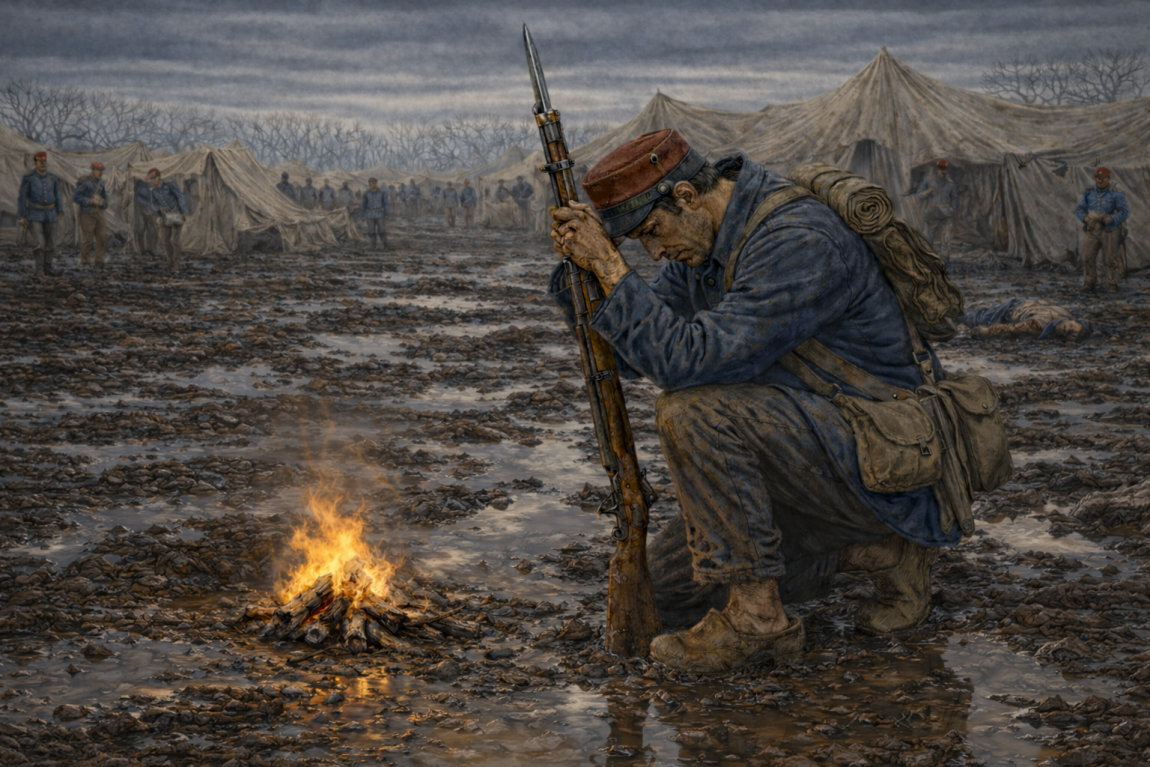
Designated by command to take charge of the camp at Conlie, whose situation is concerning, Joseph-Marie Le Bouédec arrives there on November 1, 1870. He is immediately appointed colonel, then general. He discovers a waterlogged plain, soon nicknamed Kerfank, the "city of mud." Thousands of mobilized Bretons have been waiting there for months, without sufficient weapons, under tents that let the rain in.
Le Bouédec tries to organize this army of poor souls, to maintain cohesion, to give meaning to this immobility. But the promised weapons are slow to arrive, orders remain vague, decisions shift constantly. Time passes. The mud eats away at bodies as much as at minds.
Diseases follow: typhoid fevers, dysentery, smallpox. Each day, lines of feverish, emaciated, dazed men are evacuated. Many will never return. They die far from the front, without having fought.
Gradually, Conlie ceases to be just a camp. It becomes a suspended place, held in indecision. Away from the front, there is hesitation to engage this mass of men from the West, bonded by deep loyalties and a tenacious collective memory. In truth, there is less fear of their bravery than of what they might become once armed. So, they delay. They wait. The mud does the rest.
When the Army of Brittany is finally engaged at the Battle of Le Mans in January 1871, it is too late. The soldiers fight bravely, but without sufficient preparation. They advance with rusty, mismatched, often defective rifles; wet cartridges that jam, sometimes explode in their faces. Orders are confused, lines are dislocated. Many fall without truly understanding what was expected of them. The armistice follows. The camp is dissolved.
The survivors return home on foot, exhausted, with the bitter feeling of having been engaged too late and left too soon.
Le Bouédec leaves Conlie quickly, without fanfare.
After the urgency of the sky, he has experienced the immobility of the earth and understood that some defeats consume themselves there, far from the fight. He then returns to Trégor, to Plounévez-Moëdec, to be with his own.
There, he finally stands apart from the clamor of men.
Conclusion
Joseph-Marie Le Bouédec will be remembered as a man who fell from the sky to better confront the reality of the earth. A Breton whom the chances of war threw into Alsace, welcomed and protected by men of discreet loyalty, before he returned to the West, to the lands that had shaped him.
And perhaps this is, ultimately, the discreet meaning of this story — and of so many other lives. We leave, carried by momentum, sometimes lifted too high, believing we can detach ourselves from what has shaped us. Often come the trials, the falls, the imposed detours. And one day, almost without thinking, we return to the essential: the primal earth, the familiar wind, the rocks battered by spray, the inhospitable gorse, and those evening paths where the air smells of the coming rain — all that had taught us, from the very beginning, to stand tall as well.
*Subsequent accounts will mention an exceptional altitude of several thousand meters, impossible to establish with certainty.*


Commentaires (0)
Aucun commentaire pour le moment. Soyez le premier à réagir !