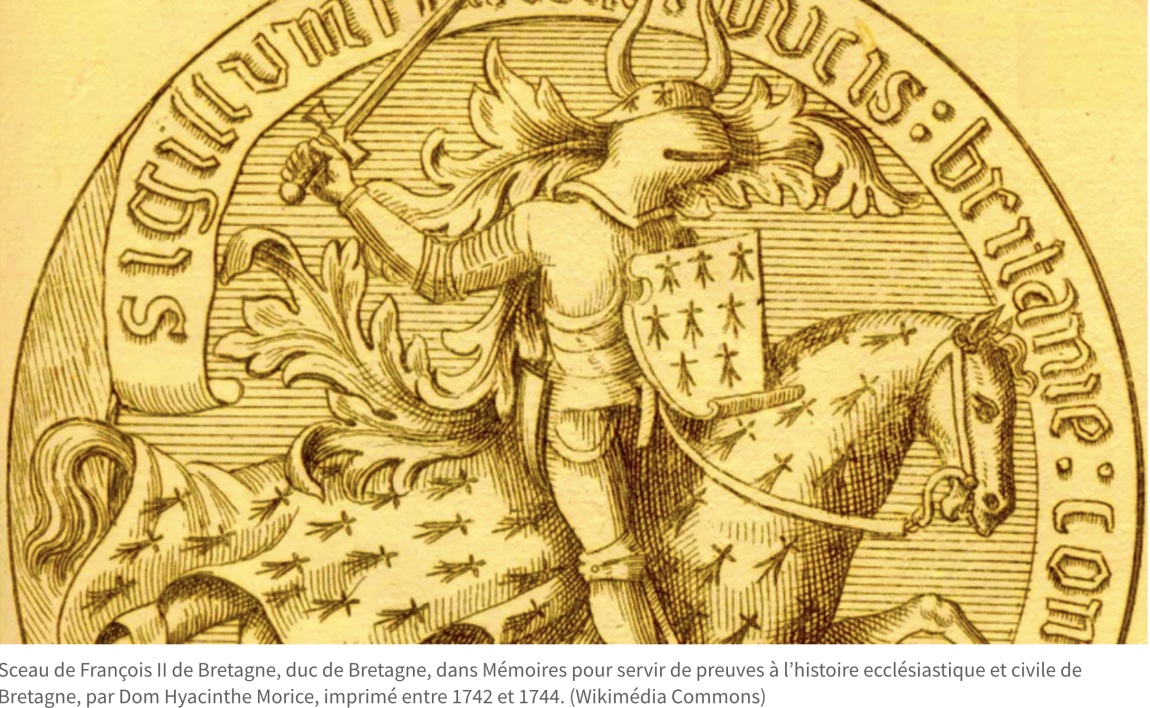
Five documentary witnesses preserved at the Archivo General de Simancas and dated from November 29 to December 2, 1483, allow us to follow the negotiation and then the implementation of an agreement between Francis II, Duke of Brittany, Ferdinand II of Aragon, and Isabella I of Castile. Bretaigne DAO publishes the references of the sources already found, what they actually establish, and the documents that still need to be located.
Brittany in European Archives
With this article, Bretaigne DAO opens a series dedicated to documents related to Brittany currently preserved in European archives. Our method is simple: to return as much as possible to primary sources, provide their exact references, and clearly distinguish what the documents establish from what pertains to an older edition, historiography, or a hypothesis yet to be verified. For this first file, we head to the Archivo General de Simancas in Spain.
A Negotiation in Vitoria in November 1483
At the end of November 1483, ambassadors of François II, Duke of Brittany, negotiate in Vitoria with representatives of Ferdinand II of Aragon and Isabella I of Castile, commonly referred to in historiography as the Catholic Monarchs. The first document we found in the Registro General del Sello is dated November 29, 1483:
Archivo General de Simancas, RGS, LEG, 148311, 60.
Ferdinand and Isabella grant power to Andrés de Villalón and Juan Díaz de Alcocer to negotiate with the ambassadors of the Duke of Brittany. This document is important, but it should not be confused with the treaty itself. The documentary edition by Luis Suárez Fernández precisely distinguishes:
No. 30: powers to Villalón and Alcocer — November 29, 1483;
No. 31: Capitulation with Brittany — November 29, 1483.
The complete primary text of this capitulation is currently one of the documents we are seeking to locate. On December 1: a first measure obtained by the Breton ambassadors. Two days later, a new act appears: AGS, RGS, LEG, 148312, 65 — Vitoria, December 1, 1483. It concerns the pardon granted to those who had exported horses to Brittany. The documentary notice specifies that this measure comes at the request of the Breton ambassadors.
This document is interesting because it shows that the Breton embassy present in Vitoria is not only involved in an abstract negotiation: it also obtains a royal decision regarding a concrete matter related to trade with Brittany.
December 2: Order to Respect Peace and Alliances
The next day, the Registro General del Sello preserves:
AGS, RGS, LEG, 148312, 237 — Vitoria, December 2, 1483.
The act orders that the peace and alliances concluded with the Duke of Brittany and his vassals be respected. The chronological succession thus becomes particularly interesting: November 29: power to negotiate; December 1: decision made at the request of the Breton ambassadors; December 2: order to respect the peace and alliances concluded with the Duke of Brittany.
But another document from the same December 2 allows us to go even further. Gutierre de Cárdenas: a judge tasked with enforcing the agreements. The Patronato Real preserves an exceptional document:
AGS, PTR, LEG, 92, 5 — Vitoria, December 2, 1483.
This is a provision from Ferdinand and Isabella designating Gutierre de Cárdenas as judge and conservator of the articles concluded with the Duke of Brittany.
The text specifically states:
“jues e conservador general”
to ensure the:
“cumplimiento e execuçion de los dichos capitulos”.
In other words, the Castilian monarchy does not merely record the existence of an agreement: it designates an officer responsible for its fulfillment and execution. The original document preserved at the Patronato Real also includes its validation elements and seal. PARES preserves it under notice 2235095.
A particularly valuable fact for administrative history, we have found a second contemporary witness of the same arrangement in the Registro General del Sello: AGS, RGS, LEG, 148312, 246 — Vitoria, December 2, 1483.
PARES: notice 1605400.
We can therefore confront a document preserved in the Patronato Real with its record in the chancellery documentation. What these documents allow us to establish: Taken together, these acts show that at the end of November and the beginning of December 1483, François II has an embassy negotiating with the Castilian-Aragonese monarchy. Ferdinand and Isabella officially empower their own negotiators. Concrete decisions are made at the request of the Breton ambassadors. An order is given to enforce the peace and alliances with the Duke of Brittany, and a conservator judge is specifically tasked with ensuring the execution of the concluded articles.
These documents thus testify to an organized diplomatic relationship accompanied by administrative execution mechanisms. However, they do not, on their own, resolve the contemporary legal debates concerning the status of Brittany. Our goal is precisely to avoid this type of shortcut: we first publish the sources, then we examine their significance in their context.
The missing pieces
Our investigation is not over.
We are particularly searching for:
the Capitulación con Bretaña of November 29, 1483 itself;
the act of December 2 concerning Jacques Bouchart;
the document of December 3 by which the Breton ambassadors would have acknowledged receiving the Castilian confirmation;
and the act of January 10, 1484 concerning Pierre Landais, conservator on the Breton side.
These documents are identified in the documentary editions, but their primary witnesses still need to be found and verified.
This is a fundamental distinction: a reference in a book is not yet a reproduction of the original.
Main sources
Archivo General de Simancas:
RGS,LEG,148311,60 — November 29, 1483.
RGS,LEG,148312,65 — December 1, 1483.
RGS,LEG,148312,237 — December 2, 1483.
PTR,LEG,92,5 — December 2, 1483.
RGS,LEG,148312,246 — December 2, 1483.
Editions and verification works:
Luis Suárez Fernández, Política internacional de Isabel la Católica, vol. II.
José Luis Orella Unzué, works dedicated to trade and maritime relations between the Basque Country and the Duchy of Brittany.
Research is currently ongoing in Simancas and several other European archives.
Brittany DAO — Historical and archival research
Series: Brittany in European archives


Commentaires (0)
Aucun commentaire pour le moment. Soyez le premier à réagir !