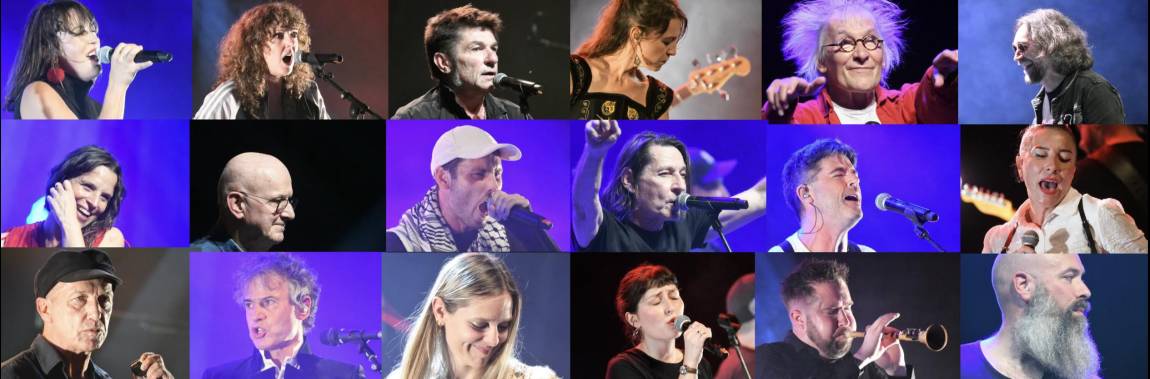
In contrast to the pessimistic discourse about the future of Breton, Gwennyn advocates for a decidedly optimistic vision. For the artist, the internet and artificial intelligence will accelerate the dissemination of the language among younger generations. She reflects for ABP on her commitment and on the momentum created with the Breizh A Live festival.
Gwennyn, whose real name is Gwennyn Louarn, born in Rennes, is a Breton singer-songwriter. She primarily composes and performs in Breton, but also in French and English. After growing up in the Crozon peninsula and being educated at the Diwan school, she has established herself since the early 2000s as one of the most modern and electro-pop voices of the Breton scene. She has also become an ambassador for Brittany internationally, performing in many countries. She currently has seven albums to her credit, and her latest is a double album from her magnificent show Enez – "He is an island…".
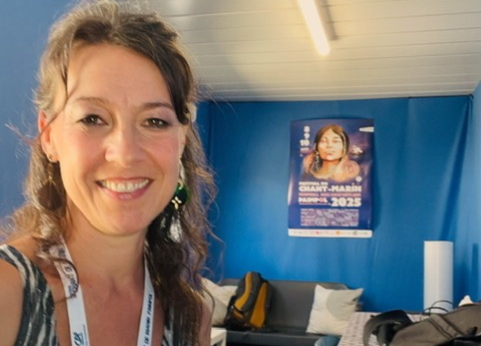
In September 2025, she initiated and led the grand concert Breizh A Live in Carhaix, an event mobilizing for the Breton language that particularly highlighted the youth speaking Breton. The concert gathered over 3,000 people and many artists. Crowned "Brittophone of the Year" at the Prizioù 2026, she continues to embody a contemporary, dynamic Brittany looking towards the future.
The Interview
[ABP] You are a recognized Breton artist with several albums to your credit and prestigious collaborations (Alan Stivell, Tri Yann, etc.). What was the trigger that pushed you to engage so strongly for the Breton language, beyond your career as a singer?
[Gwennyn] Because one does not go without the other. I am a native Breton speaker. Should I remind you that cultural resistance is in my family DNA? (Ha ha :D) When you sing in Breton, you have no choice but to talk about this language through the lens of its survival and development. Of course, I also talk about its musicality, its semantic richness, its universe. But personally, singing in Breton was not a choice. I sing as I speak. Initially, there is no activism in this approach. But others often reflect back to you the condition of the language (that it is threatened, that it is not understood by the majority, etc.). In any case, Breton has brought me luck throughout my life (as a singer, as a mother, as a woman evolving in Breton society...) so I have no trouble speaking about it positively.
[ABP] You just received the Brittophone of the Year award at the Prizioù 2026. What was your reaction upon learning of this distinction? Do you see this award as personal recognition, or rather as a validation of the entire collective movement around Breton?
[Gwennyn] I first think of all the people who should have received it before me, because the Breton-speaking community is full of activists who have dedicated all their time to its sustainability and transmission (I think of Renan Kerbiquet who was also nominated, or Matthias Le Brun the founder of "1000 Families", and many others: the list is long!). Then I thought of all those artists who trusted me to organize this beautiful event, "Breizh A Live". And just for that, we should not apologize for receiving this "recognition" award. I welcome it with joy, humility, and a spirit of collective responsibility.
[ABP] After this beautiful moment of recognition, what project is closest to your heart right now (new album, new creation, other commitment…)?
[Gwennyn] For now, it’s my next album, which will be released on November 15, 2026. The tour will start on March 6, 2027, in Quimper at the Théâtre Max Jacob. But various projects are underway in the wake of Breizh A Live. Indeed, we are heading for a second edition of this great day dedicated to the Breton language. It will be on September 11, 2027, in Morlaix. Over the next 18 months, we will have time (this time!) to think about the organization, to do almost as well as the first time! We have declared an association (open to all), consisting of several workshops to organize this next event. Additionally, I am involved in the "Musiques en Bretagne" project led by Brieg Guerveno for the rights of Breton artists to be broadcast. But Brieg can talk about it better than I can: it could be the subject of an interesting interview; he has really made great progress on the project.
[ABP] How did the idea for Breizh A Live come about in 2025? Was it a reaction to a particular urgency regarding the vitality of Breton, or the result of a longer reflection with other artists?
[Gwennyn] Yes, it was indeed a reaction to an urgency. The urgency, in particular, to correct the course regarding the communication about the evolution of our language. I no longer wanted to read negative articles in newspapers or interviews, because I am convinced that this remains a point of view. In light of our recent history, and given all that the French state has done against Breton (a policy of eradicating the language for nearly a century), the use of the Breton language today is a true miracle. We can already see that Breton has been saved. The number of speakers constantly decreasing from a certain generation (that of my grandparents) who experienced negative emotions regarding their mother tongue is slowly making way for a new generation of Breton speakers, flourishing, educated in Breton, and who have integrated all the innovations of the 20th and 21st centuries into their everyday expression. This represents about 55,000 people (most of whom are under 40), or half of the current Breton speakers. It’s modest, of course, but it’s very positive! Now, we are at a crossroads. What do we do with all this? Do we ignore this new generation? Or on the contrary, do we take advantage of this dynamic to drive it home? Support them, get on

Commentaires (0)
Aucun commentaire pour le moment. Soyez le premier à réagir !