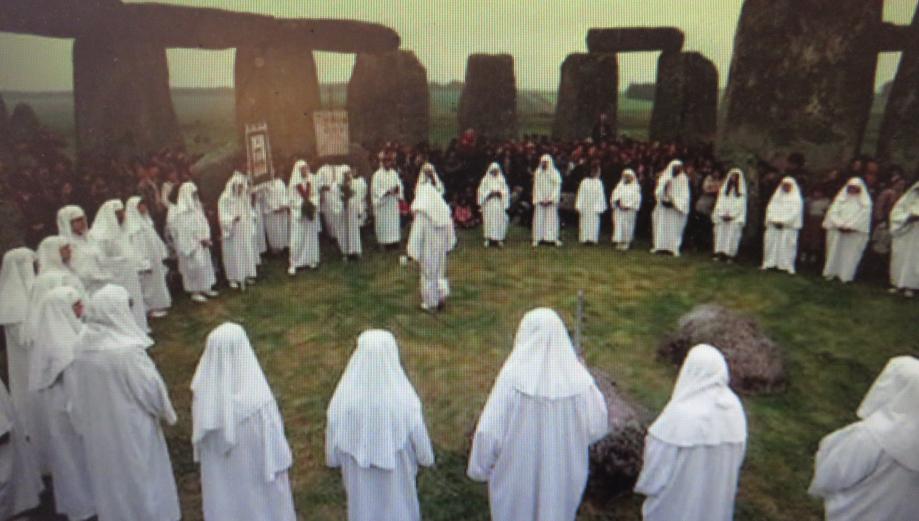
Druidism has returned to public debate following controversial statements made by Deputy Maël de Calan last April, and then an article published by Libération on May 12, 2026. ABP has been conducting an investigation into this contemporary spirituality, which is still not well known, for several weeks.
Druidism, a religion for some, a spiritual practice for others, or even a hobby for certain individuals, continues to both fascinate and raise questions. Several members of this movement regularly remind us that it is a practice "without dogma," while others assert that its existence is solely cultural. It is difficult for the layperson to navigate without losing their Latin—or should we say, their Breton or Gaulish! In the face of the plethora of disparate, even contradictory information circulating on the internet, in the press, literature, and of course on social media, ABP sought to gain clarity by interviewing some coordinators of groups that make up this contemporary "druidic ecosystem."
Current State of Druidism Today in Brittany, France, and Elsewhere on the European Continent
The term "Contemporary Druidism" refers to the movement that took root in the 18th century in Great Britain (England and Wales), and which developed along three currents later referred to as "the three Filiations," from which the current Druidic Colleges claim, to varying degrees. These Colleges or groves share at least a few common characteristics:
• They are predominantly polytheistic
• They provide both oral and written teachings
• They conduct ritual celebrations at specific times of the year
• The language used during their celebrations is most often the most widely spoken language in the country where the grove is located (English, French...), but also in Celtic languages (Breton, Welsh, Cornish, Gaelic...) or even in Old Celtic or Gaulish.
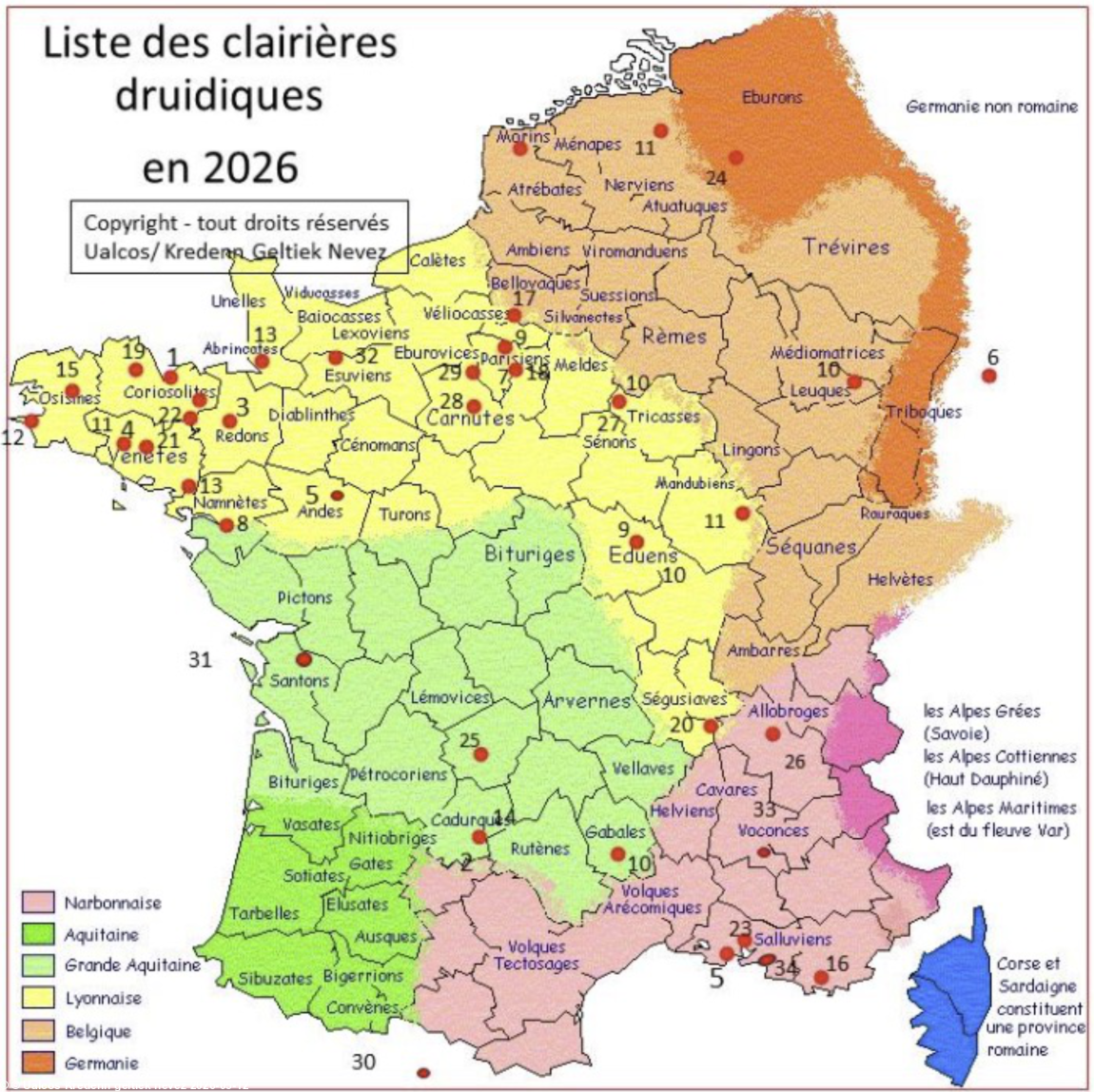
France currently counts several dozen of these colleges. Among the earliest obediences is the Gorsedd of Brittany, founded in 1899 by Taldir Jaffrennou.
There is also the tradition of grove druidism, originating from Ireland, a country that was never conquered by Rome and where Christianization was later and less violent than on the continent, allowing druidism to maintain itself better. This grove druidism, represented by the Druidic Grove of the Vilcena Forest, has launched the publications "Druidic Studies" (which describes its origins), "La Tribune Celtique," the magazine "Keltia," and scientific conferences on Celtic religion.
These have been mapped out on a chart created by Druid Ualcos of the Kredenn Geltiek Nevez and presented during the Druidity Conference of 2024 organized by Druid Bran Du (initiated at the Druidic College of the Gauls, then responsible for the CDA and now officiating within the Kildara movement).
The Role of Druids in Contemporary Society:
Officially disappeared for almost 2000 years, eradicated by the Romans and then completed by Christianity, how can one still claim to be a druid today, and what should their role be in our society?
“Archaeologists, researchers, and academics share with us the tasty fruits of their discoveries and analyses around the Indo-European, Celtic, and druidic worlds,” says Mona Braz.
Thus, while it was thought that everything was lost, that nothing had been written, the discoveries and translations of more and more texts written by Irish monastic scribes at the end of the High Middle Ages provide valuable information and help connect us to our ancestors.
Pieces of a giant puzzle are therefore coming together to give coherence to the practices. While the druid Auetos acknowledges that “liturgical and seasonal rites are somewhat different from one college to another in contemporary druidism,” he asserts that the practices are “generally homogeneous regarding rites of passage such as baptism, marriage, etc.”
Deeply linked to the “pagus” (country), one might wonder if druidism does not constitute, in its contemporary version, a coherent and adapted response to the spiritual collapse in Europe? As more and more people turn to practices such as shamanism or Buddhism, druidism can indeed represent a third way, according to Mona Braz:
“In a context of the collapse of Christianity, the still glowing embers of the sacred fire of the ancient druids are ready for new bonfires. An increasing number of people are turning to druids to find in this indigenous cosmic religion answers that the Church is unable to provide. It is not a return to the past, but the rebirth of a Tradition.”
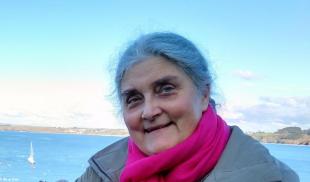
Druidism is not meant to be confined solely to the spiritual dimension. Like the ancient druids, the new ones also claim a necessity to get concretely involved in the daily life of the community. This is an aspect dear to Mona Braz, who, due to her experience as an elected member of the Regional Council of Brittany, emphasizes the role a druid should play in public life:
“Generally speaking, neo-druidism could have become an instrument of national liberation for the Brittonic peoples,” she explains. “But we still have to deal with the weight of the Protestant establishment in Wales or French centralism in Brittany! And the fact that today druidic clearings are invaded by new profiles: they confuse druid and healer, druidism and shamanism, New Age currents or other personal development. People who, moreover, have never campaigned for Brittany or are not attached to Celtic roots in general, and are blind to the convergence of political, associative, cultural, linguistic, and druidic struggles...”
Yet, she continues, “it is essential for a Druid to get involved at all levels in society. Unfortunately, we are far from the wise one whose role was, from a higher perspective, to advise the king and administer justice. The recent controversy following the ironic example used by Maël De Calan (president of the Finistère Departmental Council) regarding the druid receiving the RSA is a manifestation of this: rather than debating the reasons for the existence of the RSA (a tool for regulating a system that produces poverty, precariousness, and misery) and its allocation method, some felt it necessary to feed the media machine, accusing Maël De Calan of wanting to tarnish druidism. In doing so, they were doing him a favor, diverting the debate and attention to something else.”
Finally, it goes without saying, but it is better to say it, that the contemporary world is full of self-proclaimed druids who, being unconnected to any lineage, initiation, group, or other clearing, do not receive recognition from their peers. Beware of bad encounters, especially on social media, which could quickly slip into charlatanism or sectarian drift. The most serious groups are not always the most visible online. How, in this context, can one recognize trustworthy profiles?
Spirituality, religion, tradition, associative occupation, hobby… What is druidism?
According to the druid Auetos of the Celtiacon Certocredaron Credima, the orthodox branch of the movement, “Druidism, which is more commonly referred to as Senaca Aresta, ‘the Ancient Faith,’ was, is, and will always be a religion, that is to say, a system of beliefs that defines the relationship between Man and the sacred; a set of practices specific to its devotion; and adherence to certain certainties and convictions. In this sense, druidic religion is both personal and communal, private and public. It is recognized in the practice of worship, teaching, spiritual exercises, and behaviors in society. The druidic religion does not seek to fix its doctrine in a single expression. It willingly admits the plurality and richness of spiritual experiences.”
In short, it is a clever blend of spirituality (a more personal approach that may differ from one individual to another) and religion (which refers to specific practices and beliefs within a community). At this stage, an important clarification is necessary: in contemporary druidism, just as we can assume was the case in ancient druidism, there is a distinction between practicing believers and so-called “sacerdotal” druids. The latter are supposed to possess the necessary qualities, which will be discussed later, to organize and lead a ceremony, for example, or to deliver a teaching.
Joining a druidic group does not automatically mean that one will become a druid one day… Moreover, in the English language, saying that one is a druid is equivalent to saying that one is a Christian elsewhere, meaning involved in a personal journey rather than in a priesthood. The role of the sacerdotal Druid (who is initiated and holds a particular role in ceremonies) must be distinguished from that of the believers. It is worth noting that the United Kingdom officially recognized contemporary druidism as a religion in 2010. https://abp.bzh/le-druidisme-reconnu-officiellement-comme-religion-au-royaume-uni-20035 The commission responsible for expressing the request at the end of a five-year process concluded that “there is sufficient faith in a being or a supreme entity to constitute a religion.”
Regarding the notion of “dogma,” Druid Auetos specifies that “druidic dogma, unlike others, is subject to criticism and modification; its starting axioms can be called into question, allowing for progress toward a common understanding of a multiple faith.”
This is a very different conception from those of Middle Eastern religions, where what is written should remain unchanged, regardless of societal evolution.
For Mona Braz, author of “Secrets of a Druidess” published by Robert Laffont, “druidism is the cosmic religion of the Celts. This is the postulate I lay on a religious geology that is 4,000 years old.
It is good to remember this, as the word religion has been confiscated by the only religions of the Book (Judaism, Christianity, Islam), relegating indigenous religions to a desire for declassification, placing them in the category of pagan beliefs.
And yet, the anthropological phenomenon that is religion concerns humanity for millennia before the arrival of the three currently dominant religions. In my book "Secrets of a Druidess," I specify that the two origins of the word religion are religare and religere: to reread and to connect. The two are inseparable: rereading one’s presence in the world and rereading oneself is found in the saying “Know thyself, and you will know the entire universe and the gods”; to connect and to be connected indicates the knowledge of our biological, psychic, and spiritual interdependence in the material, invisible, and divine worlds.
The foundational stones of this religion are:
The True, the Truth, and the Just
The Search, knowledge, and Understanding
The Comprehension, Love, and Goodness.
What are the beliefs of this "Ancient Faith"?
First of all, it must be noted that knowledge about ancient druidism remains fragmentary. Druidism, or should we say at this stage "the religion of the Celts," is polytheistic in nature and emphasizes the connections that unite druids, believers, the Earth, and the Sky, the "land" (pagus, brogis). For many Druids, these connections are not merely coincidental but "sacred." The druid honors the Earth because it holds both the memory of ancestors, the symbols of the World of Deities, and the manifestations of Life (Arzh Gadarn, Grand Druid of the Druidic College of Gaul, stemming from the Bardic College of Gaul founded by Philéas Lebesgue, officially recognized in 1933 by the Gorsedd of Wales).
For Mona Braz, "The pivot of beliefs is the immortality of the soul, which is associated with responsibility, courage, and the reduction of evil. This translates into a discipline in our daily lives. For, connected to the cosmos, our thoughts-words-actions resonate to the farthest reaches of the universe, which sends back their echo. Standing between Earth and Sky, as priests, druids are intermediaries between the lower, middle, and upper worlds and their deities."
Essential criteria for identifying a serious druid.
For the druid Auetos, “a druid is above all a theologian, an advisor, a spiritual and temporal guide, but also a knowledgeable person who has benefited from a proper education in a recognized druidic college, acknowledged by their peers.” In other words, self-proclaimed druids, not recognized by others, should not use this title.
Mona Braz calls for the revival of the prayer known as the “prayer of the druids,” which is recited by most practitioners, in its French version:
“Give us, O Divinities, your Support, and in your Support, Strength; and in Strength, Understanding; and in Understanding, Knowledge; and in Knowledge, knowing what is Just; and in knowing what is Just, Love; and in Love, the Love of all life, the Love of you, O Divinities, and the Love of all Goodness.”
Based on the elements of this prayer, it would be easy to discern among those who claim to be “druids” who truly live in Understanding, in Knowledge, in the Just, in Love, and in Goodness.
The druidess warns about the phenomenon of social networks, where words and behaviors are revealing: “In the sense that they reveal the opposites of druidic Virtues, namely: ignorance of soul opposed to Understanding and Knowledge, egocentrism and greed opposed to the Just; hatred and exclusion opposed to Love and Goodness...”.
Finally, according to Arzh Gadarn, Grand Druid of the Druidic College of the Gauls, a “good druid” must:
• Have rigor
• Commit to discretion, not constantly displaying their qualities
• Be a guide, educator, helping the members of their College to find their own solutions
• Know how to accompany as much as lead
• Be respectful of others, even if they have an opinion that seems “different” to them
• Be able to explain in simple terms the purpose of Druidism to both neophytes and those already on the Path. As a general rule, apply the saying: “What is well conceived is clearly stated”
• Be capable of answering all questions posed to them, thus continually improving their knowledge, and not hesitate to question it if erroneous information is discovered
• Have a genuinely fraternal and brotherly attitude towards other Colleges
• Commit to serious research of ancient texts, most often in Irish (the list is included in the Comardia Charter)
• And finally: not to monetize their services
In order to combat the deviations within this movement, it has become necessary for existing groups to unite around fundamental principles. In 2011, a large gathering of all the continental druidic Colleges that were willing to respond to the call was organized in the municipality of Aubazine (Corrèze). The objective of this gathering was to formally identify all the points that could be common to all these groups, regardless of their size and geographical location, and to attempt to draft a document in which all could recognize and mutually identify themselves. The drafting of this document required the participation of all present, men and women, regardless of their College and their internal mode of operation.
The documents related to this gathering in Aubazine, named Comarlia, are available at the following address: https://comarlia.forums-actifs.com/t220-la-charte-de-comarlia
More recently, a dozen groups also signed a second ethical charter.
of Contemporary Druids… and Druidesses?
According to the druid Auetos, "The druid must conduct research in the druidic field and Celtic culture. Through his knowledge, which goes well beyond theological understanding, he is the guardian of tradition. His role, as a priest, is to officiate in the place that is his, among his own, that is, the community of believers that legitimizes him."
The woman-druid, although a priestess, is essentially a prophetess, a seer, a magician, a "witch," a healer, a caregiver, a teacher, an initiator, but also a poetess and a satirist. Through her functions, she views her task as a complete whole, both physical and symbolic.
The difference between the druid and the woman-druid is symbolic. She is the night when he is the day; she is lunar when he is solar; she is water when he is fire. Their activities, although different from an external perspective, are above all complementary. They are like the two halves of the same circle forming a homogeneous, harmonious, and perfect structure. This difference in no way implies that the activities of the druid surpass or prevail over those of the woman-druid. There is no discrimination or segregation due to the nature of their sex.
For her part, Mona Braz questions the "Mathilda effect" in druidism. During her intervention at the 3rd Druidry Conference, she stated: "The Celtic woman constitutes a unique case in ancient history, even though we have few separate elements in the Irish sources, because they were transcribed late, providing usable information about her, through the great legendary cycles. But this little is enough for us to deduce, even affirm, the existence of a category of Celtic women warriors, priestesses, seers, and those in charge of military and sexual initiation of young men..."
I invite you to consult pages 468 to 473 of the Dictionary of Celtic Mythology and Religion, a classic and essential work by Philippe Jouët, reissued in 2025: it discusses the range of definitions that the word "woman" can encompass for the Celts. Among other things, you will find accomplished woman, woman druid, woman of knowledge, sovereign, queen, woman physician, poetess, mistress of poetic art, seer, prophetess, satirist, musician, horse-riding messenger, powerful woman, witch, woman of the Sidh, woman of war, heroic woman, hospitable woman,... In other words, everything a man can do, a woman can do as well. Women occupy the same roles as men, without being the female counterpart.
Moreover, women were still present in the Christian priesthoods of Brittany in the 5th century: Breton priests were admonished by Frankish bishops in the 5th century CE for having accepted women with them during religious ceremonies. This is attested by the famous letter from Melaine of Rennes (a bishop collaborating with the Franks), sent to two Breton priests (that is, from Brittany), Lovocat and Cahitern, who traveled to Celtic lands accompanied by two women with whom they co-celebrated the masses. It should be noted that the presence of female elements during the Eucharist was not prohibited in Gaul until the 4th century CE, and despite this, the Bretons showed a certain reluctance to apply this ban from the Roman Church.
The ABP thanks, for their contribution:
The Druidess Mona Braz, author of "The Secrets of a Druidess" published by Robert Laffont
The Druid Auetos of the Celtiacon Certocredaron Credima
The Druid Arzh Gadarn, Grand Druid of the Druidic College of the Gauls
The Druid Ualcos of the Kredenn Geltiek Nevez
Fabien Régnier


Commentaires (0)
Aucun commentaire pour le moment. Soyez le premier à réagir !