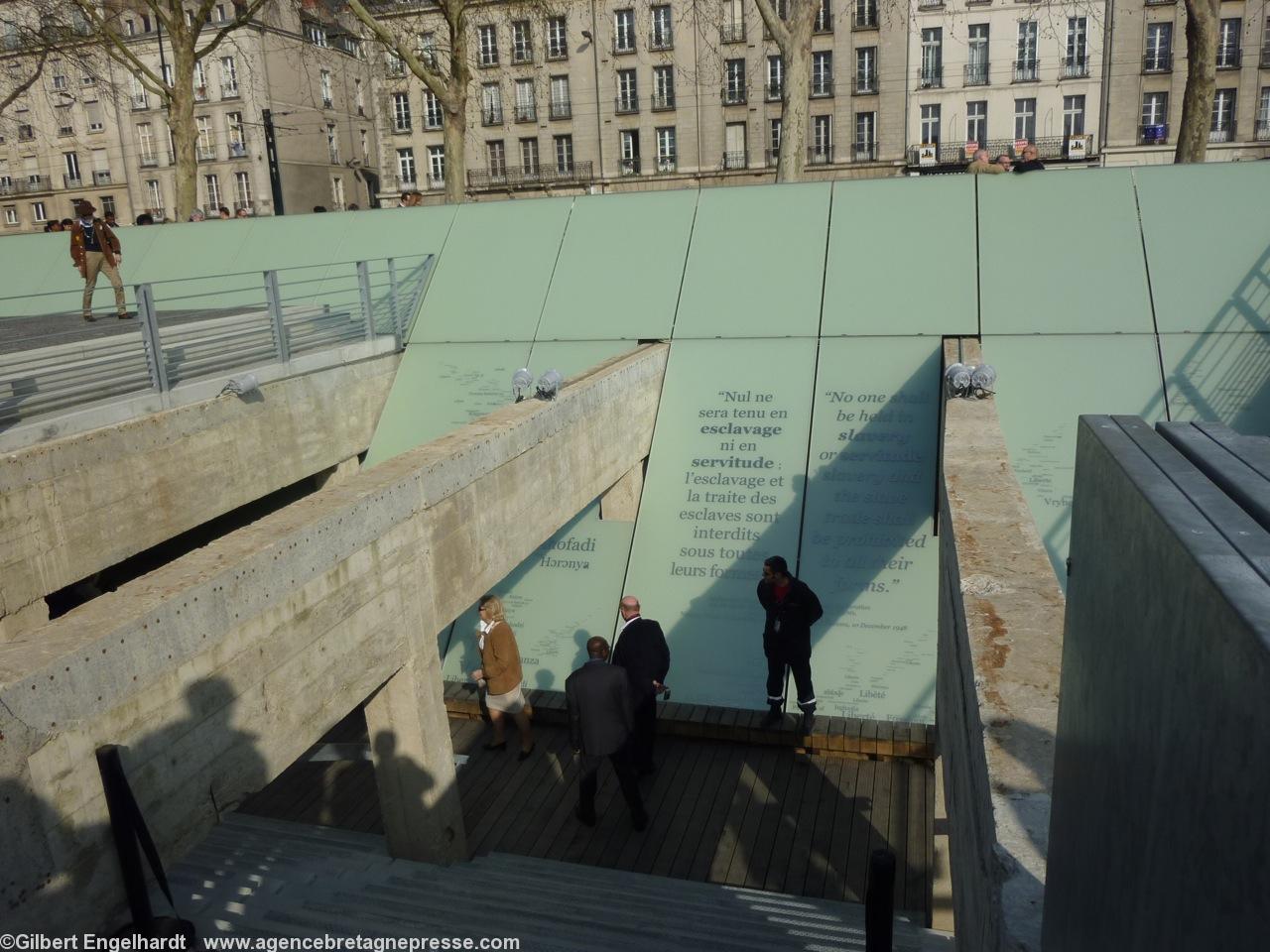
After two years of work, the Slavery abolition Memorial opened its doors to the public, in Nantes, on Sunday, March 25, at 15 pm, at the very spot where 43 % of 4,100 French slave trade shipments took to sea.
After two years of work, the Slavery abolition Memorial opened its doors to the public, in Nantes, on Sunday, March 25, at 15 pm, at the very spot where 43 % of 4,100 French slave trade shipments took to sea.
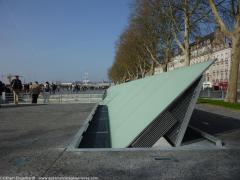
The memorial, a first in Europe, is one of the most important monuments in the world devoted to the slave trade, slavery and its abolition. Designed by the Polish artist Krzysztof Wodiczko and the American architect Julian Bonder, this memorial is also intended as "an artistic work", explains Françoise Vergès, President of the slavery memory and history Committee). We visited the monument of impressive size, pacing the underground tunnel of 90 m long, on the Loire bank , under the Quai de la Fosse. Beyond the pillars and concrete structures, the river flows, majestic. A wall made of 2,000 glass plates engraved, each devoted to an expedition, recall to our memory that Nantes, in the eighteenth and nineteenth centuries was, on the Atlantic coast, with Bordeaux and Liverpool, one of the triangular trade centers. More than 450,000 Africans have been deported, mainly to the French Antilles. Along these glass plates dedicated to trafficking itself, quotations from writers and historians call us to meditate. As requested by the designer, "visitors will experience the confinement felt by the slaves on their shipping."
A 1.5 kilometers journey starting point and eleven emblematic places
This Quai de la Fosse memory place, is the starting point of 1.5 kilometers journey, which stretches through Nantes, punctuated by eleven emblematic places, the last step is the Chateau des Ducs de Bretagne, the History Museum with several rooms devoted exclusively to the Nantes triangular trade.
The knowledge of the past
We must consider that this memorial symbolizes the acceptance by all of the slaves history, both for Europeans and Africans and Americans. To better build the future and understand the present, knowledge of the past is essential.
A 7.9 million euros investment
Only drawback we could make to the memorial building , would be its cost that seems prohibitive. We must remember that the investment, co-funded by Nantes Métropole, the ERDF, the Pays de Loire Region and the city of Nantes is of a considerable importance, probably disproportionate to the present era of budget restrictions (originally planned on a budget of 6.9 million euros, the final cost ultimately will approach 7.9 million euros).
Gilbert Engelhardt translated from


Commentaires (0)
Aucun commentaire pour le moment. Soyez le premier à réagir !