

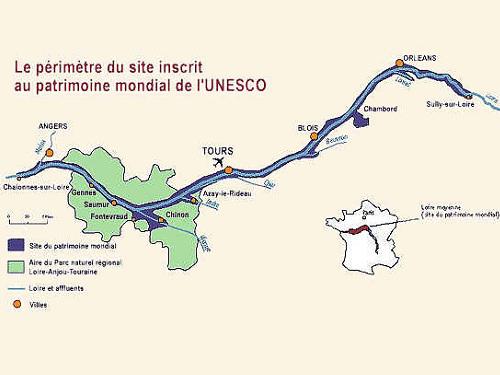
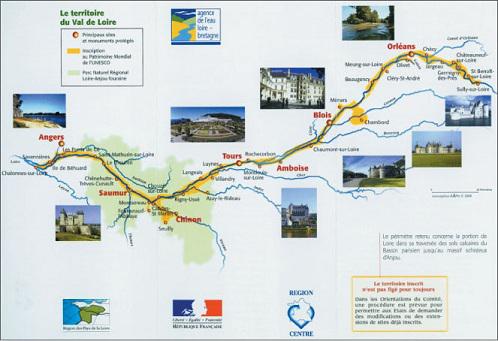
In 2000, Unesco has classified the Loire Valley as part of the World Heritage in France, from Sully-sur-Loire to Chalonnes, very next to the border of Brittany (the Loire-Atlantique part). This time the Château des Ducs de Bretagne in Nantes ends up among the castles of the Loire, and the site listed by Unesco has been extended up to the sea without any authorization.
Press release. Nantes May 2nd 2011
Subject : Loire Valley Val de Loire (France)
In 2000, Unesco has classified the "Val de Loire" (Loire Valley in France) as part of the World Heritage, bounding its perimeter that can use this naming. Located between Sully-sur-Loire and Chalonnes in the « Maine-et-Loire » it therefore comes to the border of Brittany (the Loire-Atlantique part). http://whc.unesco.org/fr/list/933
The temptation was thus great for the City of Nantes – thats owns the Château des Ducs de Bretagne – and for the Pays de la Loire Region, both hostile to the Breton identity of the Department of Loire-Atlantique, to falsify tourist and historic documents by attempting to integrate the Nantes country in the "Val de Loire".
Already in July 2009, warned by three associations of Brittany (1), the Heritage Branch of Unesco, on the occasion of the publication of a booklet titled "Valley of the Kings' – 650,000 copies printed – had confirmed that the castle of the Dukes de Bretagne in Nantes, and the wines of the Pays Nantais, are not part of the Val de Loire. Letter on PDF1 [and

One might have thought that the clarification by Unesco would have been sufficient to calm down the falsifiers.
Despising the reliability and the quality of the classifications of Unesco, smuggling has continued because, this time, it is the Castles of the Loire, and the major sites of the Val de Loire, that were the targets of manipulators. The Château des Ducs de Bretagne in Nantes ended up among the castles of the Loire (2), and the site listed by Unesco has been extended up to the sea (across the whole department of Loire-Atlantique which is NOT in the official classified zone) without any authorization. http://www.loire-chateaux.org of the so-called and enlarged “Châteaux de la Loire” and look at the tourist leaflet “Castles of the Loire” Finest France.
If one can remain sceptical in front of the mediocrity of this approach, one can only wonder about the level of esteem that the perpetrators feel for the inhabitants of the Loire-Atlantique, their history, their cultures and their ability to react.
Unesco has been challenged once again on this new political diversion from the classified site. And this time, by a letter dated April 21, 2011, the Organization confirms their request to the Permanent Delegation of France to Unesco to please remedy this situation, financed with public money.
Ultimately, it is the ranking of the « Val de Loire World Heritage Site » which may be lost IF the City of Nantes and the Pays de la Loire Region keep on falsifying history to redraw the boundaries of Brittany and assimilate the inhabitants of Loire-Atlantique.
On June 18th, 2011, all inhabitants of the five departments of Brittany (Finistère, Côtes-d'Armor, Ille-et-Vilaine, Loire-Atlantique, Morbihan) and all those who love Brittany, are invited to come to Nantes to claim the stop of this misleading policy and ask the administrative reunification of Brittany. Our taxes will be best used and, internationally, we will gain visibility, instead of being ridiculed by a few celtophobe elected representatives. http://www.bretagneenresistance.eu/index.html of the meeting of June 18th in Nantes
(1) Identity of the three Breton associations signing this release. See PDF 2.
(2) In brief, the castles of the Loire are known to be the holiday stays of the French kings, and not the Middle Age castles built against the French attacks.
Bretagne Réunie
BP 49032
44090 Nantes / Naoned
https://www.bretagnereunie.bzh
e-mail: contact@bretagne-reunie.org
Translation Maryvonne Cadiou from




Commentaires (0)
Aucun commentaire pour le moment. Soyez le premier à réagir !